Health care is a Schedule 1 use under the Terrorism (Protection of Premises) Act 2025, so NHS premises are in scope in principle. The tier depends on peak occupancy, staff included: under 200 is out of scope, 200 to 799 is standard tier, and 800 or more is enhanced tier. Most acute hospitals will be enhanced. Many GP surgeries and small clinics will not. The real task for a Trust is deciding where each premises begins and ends, and who is responsible for it.
A common assumption in NHS estates teams is that public-facing buildings will sit in Martyn's Law's enhanced tier. Some will. Many will not. And a surprising number will sit in both tiers at once, depending on where you draw the line.
The Act does not tier organisations. It tiers premises. For a Trust running an acute hospital, a handful of community sites, clinics in shared buildings and space inside a retail park, that means one organisation can hold enhanced, standard and out-of-scope premises simultaneously.
The real compliance task is not deciding whether the NHS is enhanced tier. It is mapping a diverse estate, drawing defensible boundaries around each premises, and knowing who is responsible for what inside them.
How the tier is decided
Health care is one of the uses listed in Schedule 1 of the Act. The Home Office statutory guidance confirms this includes hospitals, primary care clinics, and doctor and dentist surgeries.
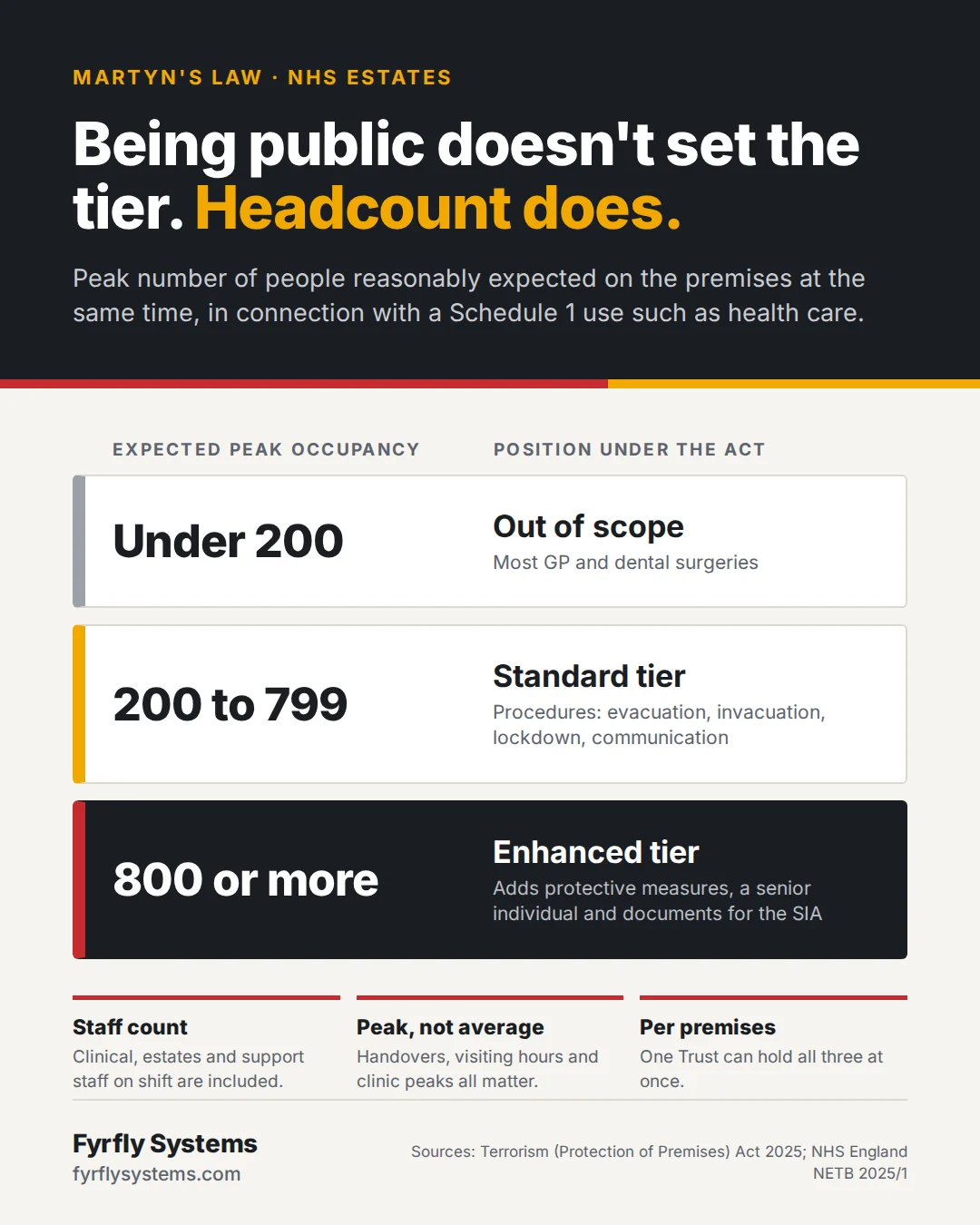
Whether a given premises is in scope, and which tier it falls into, then turns on one question: how many people can reasonably be expected to be present at the same time, from time to time, in connection with a Schedule 1 use.
| Expected peak occupancy | Position under the Act | Typical NHS examples |
|---|---|---|
| Under 200 | Out of scope | Most GP and dental surgeries |
| 200 to 799 | Standard tier | Larger health centres, community hospitals, some outpatient blocks |
| 800 or more | Enhanced tier | Most acute hospital sites |
Three points trip people up.
- Staff count. The figure includes staff, not just patients and visitors. A hospital with modest public footfall can still pass 800 once clinical, estates and support staff on shift are included.
- Peak, not average. NHS England's guidance is explicit that the assessment is the highest number reasonably expected at any one time, not average daily attendance. Shift handovers, visiting hours and outpatient clinic peaks all matter.
- Public status alone decides nothing. A building being publicly accessible does not put it in the enhanced tier. A busy GP surgery with 150 people at peak is out of scope. A health centre with 400 is standard tier.
There is also no cap for health care. The Act places early years, school and further education settings in the standard tier whatever their size. Hospitals get no equivalent treatment, so an acute site above 800 is enhanced tier.
Where the boundaries get hard
The Act defines premises as a building, part of a building, or a building and other land. That flexibility is where NHS estates become complicated. There are four situations every Trust will recognise.
Parts of a building
A hospital may contain a public café, a retail pharmacy or a shop run by a third party. NHS England's technical bulletin notes that each of these could be assessed independently, and may fall into a different tier from the hospital around it. At the same time, they remain part of the larger premises. Both sets of duties can apply at once.
Hospital campuses
Many acute sites are groups of buildings: main block, outpatients, mental health unit, education centre, staff residences, multi-storey car park. The Act allows a group of buildings to be treated as a single premises, but gives no definitive test. NHS England points to geographical proximity and whether the buildings are under the same responsible person's control.
This choice matters. Treat the campus as one premises and the whole site is likely enhanced tier. Treat buildings separately and a satellite outpatient block might be standard tier, or out of scope. Neither answer is automatically right. What matters is that the decision is reasoned, recorded and consistent with how the site actually operates.
Premises within premises
Health on the high street means NHS services increasingly sit inside other qualifying premises. A community diagnostic centre in a shopping centre is the obvious example. NHS England cites the Metro Centre in Gateshead, which houses NHS diagnostic, pharmacy and optometry services. The unit may be its own qualifying premises, while the shopping centre is a larger one with its own responsible person and tier.
Leased and shared space
On most estates, some buildings are leased out and others are leased in. Some are shared with other providers, local authorities or universities. The question is never just who owns the building. It is who controls it in connection with the Schedule 1 use.
New in September 2026: the Principal Use of Premises Regulations 2026 come into force on 15 October 2026. Where a single premises has two or more Schedule 1 uses, the regulations set out how to identify the principal use, looking first at the use that relates most closely to the purpose and nature of the premises, then at factors such as the share of space and time given to each use. Whoever controls the premises for that principal use is responsible. The SIA has made clear this applies to individual premises with several uses, not to a site made up of separate premises, so the boundary question comes first.
Who is responsible
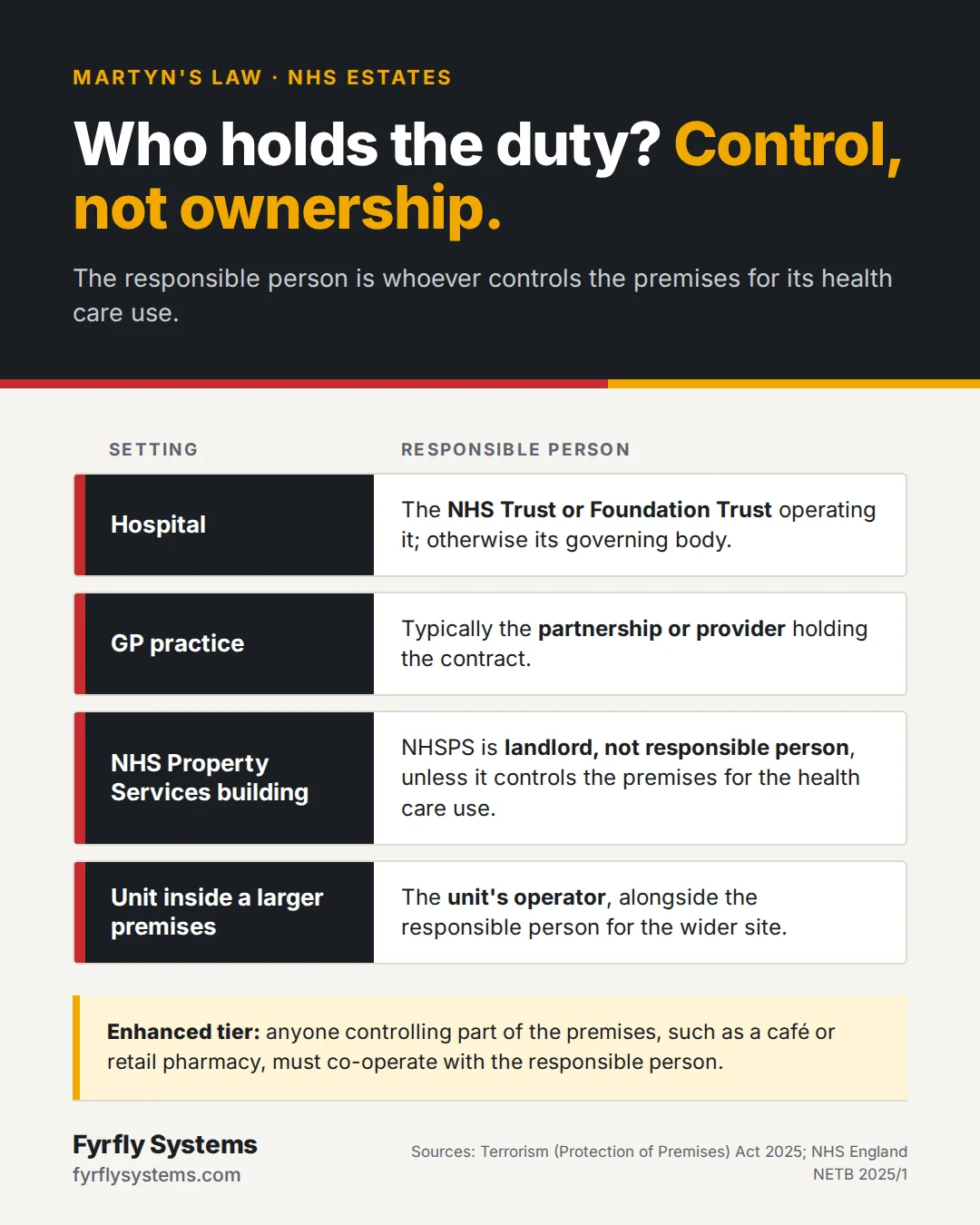
The Act places duties on the responsible person: whoever controls the premises in connection with its Schedule 1 use. For most premises that means the operator, not the landlord. Hospitals are handled differently.
| Setting | Responsible person |
|---|---|
| Hospital | The NHS Trust or Foundation Trust operating it; otherwise the hospital's governing body |
| GP practice | Typically the partnership or provider holding the contract and running the premises |
| NHS Property Services building | NHSPS is landlord, not responsible person, unless it controls the premises in connection with the health care use |
| Unit inside a larger premises | The operator of the unit, alongside the responsible person for the wider site |
Where several organisations share a qualifying premises, the Act requires them to co-ordinate so far as reasonably practicable. For enhanced tier premises it goes further. Anyone who controls part of the premises, even if they are not the responsible person, must co-operate with the responsible person.
In practice that means the café operator, the retail pharmacy, the leased-in university teaching block and the private patient unit all become part of the Trust's compliance picture. Leases, licences and service agreements written before 2025 will rarely say anything about this.
What the enhanced tier asks of a hospital
Standard tier premises need public protection procedures: evacuation, invacuation, lockdown and communication. Many Trusts are already close here, because the NHS EPRR Core Standards cover the same ground.
The enhanced tier adds public protection measures, implemented so far as reasonably practicable, across four areas:
- Monitoring the premises and immediate vicinity, from staff awareness to CCTV and control rooms.
- Controlling movement into, out of and within the premises, through access control, locks, barriers and search policies.
- Physical safety and security, including stand-off, glazing and hostile vehicle mitigation.
- Security of information, such as floor plans and security protocols.
Hospitals raise particular tensions here. They are open around the clock. Emergency departments cannot be locked down in the way a stadium can. Ambulance routes, patient transport and delivery bays complicate vehicle mitigation. Lockdown that protects a public atrium may trap a clinical area that must stay reachable. The "reasonably practicable" test exists for exactly these trade-offs, but the reasoning has to be written down.
That is the other enhanced tier requirement. The responsible person must document its procedures and measures, explain how they reduce risk, and give that document to the Security Industry Authority (SIA). Where the responsible person is an organisation, it must also appoint a Designated Senior Individual. NHS England recommends this is the Trust's Accountable Emergency Officer, who already holds board-level responsibility for emergency preparedness.
A practical method for mapping the estate
This approach turns a vague question into a register the board can sign off.
- List every site and building. Owned, leased in, leased out, shared and licensed. Include satellite clinics and space inside other organisations' premises.
- Identify the Schedule 1 use of each. Health care will dominate, but note cafés, retail, conference and education space, and anything mainly used for something else, such as an office-only building.
- Establish peak occupancy. Use real data where you have it: access control logs, rota and shift patterns, outpatient bookings, visiting policies, footfall counters. Count staff. Record the method, not just the number.
- Draw the premises boundaries. Decide which buildings are grouped and which stand alone, and which internal areas are separate premises. Write down why, with reference to proximity and control.
- Settle principal use where it matters. For any single premises with more than one Schedule 1 use, apply the Principal Use of Premises Regulations 2026 and record the outcome.
- Assign a tier to each premises. Out of scope, standard or enhanced.
- Name the responsible person for each. Flag every premises where another organisation controls part of it, and every Trust unit sitting inside someone else's premises.
- Check the agreements. Review leases, licences and service agreements for co-operation, information sharing and access to security systems.
- Gap-assess against the duties. Procedures for standard tier. Procedures, measures and documentation for enhanced tier.
The output is a Martyn's Law premises register. It becomes the backbone of Premises Assurance Model returns, the enhanced tier documents sent to the SIA, and the capital plan for any security work that follows.
Timeline and assurance
The Act received Royal Assent on 3 April 2025, and the Government committed to an implementation period of at least 24 months. April 2027 is the earliest point the duties could commence, not a confirmed deadline. The final date will be set by commencement regulations. NHS England's technical bulletin anticipates SIA compliance assessments from April 2027, which is a sensible planning assumption. Our Martyn's Law tracker follows every official update.
NHS England has built Martyn's Law into the Premises Assurance Model. Organisations were asked to categorise sites by tier in the 2025 return, and PAM is being updated in 2026 and 2027 to collect further compliance data. Trusts have also been asked to name their responsible persons.
On enforcement: once the duties commence, the SIA can issue compliance notices, restriction notices and monetary penalties. For enhanced tier premises the maximum penalty is the higher of £18 million or 5% of revenue. NHS England has advised boards to review directors' and officers' insurance in light of the new duties.
A Trust that has not yet drawn its premises boundaries has little time to act on the answer before commencement, whenever it is confirmed.
Getting the boundaries right
For most NHS organisations, Martyn's Law will not be a single compliance project. It will be dozens of smaller ones, each shaped by a boundary decision made early. Draw the lines too wide and you commit the whole estate to enhanced tier measures it may not need. Draw them too narrow and you risk under-protecting sites that clearly qualify, with the Trust's name on the enforcement notice.
The organisations that will find commencement manageable are those that treat boundary-drawing as the first piece of security work, not an administrative preliminary.
Fyrfly Systems works with public sector estates on premises mapping, occupancy assessment and the monitoring, access control and CCTV measures the enhanced tier calls for. Our free security compliance checker includes an NHS estates option, and the Martyn's Law guide covers the Act in full.
Frequently asked questions
Are NHS hospitals in the enhanced tier under Martyn's Law?
Not automatically. Health care is a Schedule 1 use, so NHS premises are in scope in principle, but the tier depends on how many people can reasonably be expected to be present at the same time. Premises where 800 or more people, including staff, may be present are in the enhanced tier. Most acute hospitals will meet that threshold. Many GP surgeries, dental practices and small clinics will not, and will be standard tier or out of scope.
Do staff count towards the Martyn's Law occupancy thresholds?
Yes. The 200 and 800 thresholds include staff as well as patients and visitors. NHS England's guidance also says the figure is the highest number reasonably expected at any one time, not average daily attendance, so shift handovers, visiting hours and clinic peaks matter.
Who is the responsible person for an NHS hospital under Martyn's Law?
The Act makes specific provision for hospitals. Where premises are used as a hospital, the responsible person is the NHS Trust or NHS Foundation Trust operating it, or in other cases the hospital's governing body. For GP practices it is typically the partnership or provider that holds the contract and runs the premises. NHS Property Services is usually the landlord rather than the responsible person.
Is a hospital cafe or pharmacy treated as separate premises?
It can be. The Act treats part of a building as premises, so a public cafe or retail pharmacy inside a hospital may be assessed as its own premises and fall into a different tier, while still forming part of the wider hospital premises. Where a single premises has more than one Schedule 1 use, the Principal Use of Premises Regulations 2026 decide which use is principal and therefore who is responsible.
When do the Martyn's Law duties come into force for the NHS?
The Act received Royal Assent on 3 April 2025 and the Government committed to an implementation period of at least 24 months. April 2027 is therefore the earliest point the duties could commence, not a confirmed deadline; the date will be set by commencement regulations. NHS England's technical bulletin anticipates Security Industry Authority compliance assessments from April 2027, so Trusts should plan on that basis.
Sources
- NHS England, NHS Estates Technical Bulletin 2025/1: Terrorism (Protection of Premises) Act 2025, application to healthcare buildings (November 2025)
- Home Office, Terrorism (Protection of Premises) Act 2025: statutory guidance
- Terrorism (Protection of Premises) Act 2025 (2025 c. 10)
- The Terrorism (Protection of Premises) (Principal Use of Premises) Regulations 2026 (SI 2026/1005)
- Home Office, Terrorism (Protection of Premises) Act: principal use of premises (September 2026)
- Security Industry Authority, Martyn's Law: scope, support and what's next (September 2026)
This article is general guidance, not legal advice. NHS England's bulletin covers England only.